Survey at the addressSheet 1 of 6
Nothing on this sheet is filled in over the telephone. Cubic metres, doorway widths and the distance to the nearest legal standing place are things somebody has to be in the room to write down. Stage one runs in this order, each step handing a figure to the next.
- At the kerbWhere a body can legally stand, how far that is from the door, and the gradient, which above Uphill is not a detail.
- At the doorThe narrowest doorway on the route out, the turn at the head of the stairs, and whether a lift exists and can be held.
- Room by roomCubic metres by tape, what comes apart, what travels made up, and what will not be carried at all.
- Loft, garage, shedThe hatch opened and the outbuildings counted, anything for clearance split onto its own list.
Pack, wrap and labelSheet 2 of 6

Packing decides how fast the other five stages go. A carton filled to the lid and square at the corners gets picked up once and put down once, in the right room. A half-full one collapses under the carton above it and turns the floor tier into a problem at the far end.
Cartons are written on twice, lid and one long side: room packed in, room going to, and the number out of that room’s total. Rooms not in use that night are sealed first; the kitchen is packed last, so the kettle is the final carton on and the first one off.
Illustration drawn for this page.Load the body in reverseSheet 3 of 6
A body is loaded backwards. The headboard end takes what comes out last and the tail takes what comes off first, so the lift is never holding a wardrobe while somebody looks for the bed slats underneath it.
Square, boxed and heavy goes against the headboard and stays there. Cartons fill the floor from the headboard back, largest at the bottom, until the tier is flat enough to stand furniture on. Each tier is strapped to the load rail before the next is started.
Transit, and the roads it usesSheet 4 of 6
-
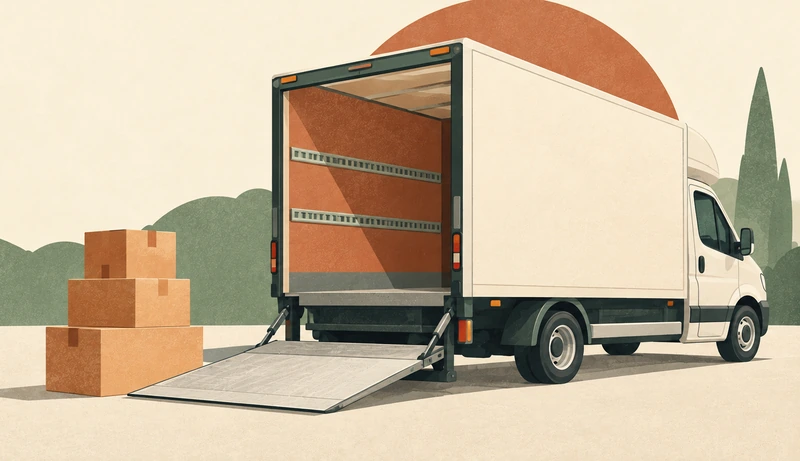
The class the volume panel reaches first for most two and three bedroom houses: a 3.5 tonne Luton body, 20 m³ nominal, tail lift at the rear. Illustration. -
Junction 21
The exit for Weston-super-Mare itself, Worle and St Georges. Anything inside BS22 to BS24 runs off it, and on a local job it is often the day’s only motorway movement.
-
Junction 22
Burnham-on-Sea, Highbridge and the levels. TA8 and TA9 work leaves here, and the lanes beyond are single track in places, which can decide the van class before the volume does.
Off the motorway, the A370 runs north-east to Bristol, the A371 inland to Banwell and Axbridge, the A38 under the Mendip edge. A completion time that moves is the ordinary case: a strapped load can sit in a locked body while the solicitors finish.
Unload and placeSheet 5 of 6
Cartons go to the room on the label, not to the hall floor.
The destination gets its own short survey before anything comes off: where the body can stand, which door the route runs through, where protection goes on the carpet and newel post, and which room is which. Beds go up first, because a bed frame is what nobody wants to be hunting for at nine at night. Furniture taken apart is rebuilt where it will live.
Three things are not done, better read here than heard on the day: gas appliances are not disconnected or reconnected, a washing machine is not plumbed in, and an unsafe stair is not carried up anyway.
Walk the inventory and sign offSheet 6 of 6
The last stage is paperwork done standing up: the inventory walked room by room against the sheet written at the other end, nothing signed until each line below closes.
| Walked | Read back against | Closed when |
|---|---|---|
| Cartons, room by room | the room counts written at the origin | every room's count reads back |
| Furniture and boxed items | the inventory list | each line is ticked |
| Dismantled items | the dismantle list | each one is rebuilt and ticked back |
| Keys and fobs | what was handed over at the start | the count agrees at the door |
| Bay suspension signs | the permit paperwork | they are off the kerb and in the cab |
| Blankets, straps, wardrobe cartons | the vehicle load list | they are back on the van |
The allowances this sheet multipliesWorking figures
Both panels on this page run on flat allowances, printed here so the arithmetic can be checked by hand.
Allowances, per the panels above
- Wrap, blankets and stack void
- +12%
- Handled items per cubic metre
- 7
- Pick up, carry, set down
- 30 s
- Carry distance, counted both ways
- 1.1 s per metre
- Stair flight, carried on foot
- 16 s
- Lift cycle, shared over 8 items
- 40 s + 4 s a floor
- Crew the day is divided by
- 3
Flat planning figures.
None of it is a quotation: a figure that can be relied on arrives in writing, by email.
The ground covered, and the other five sheetsSheets 2 to 6
The patch is BS22 to BS24, the TA8 and TA9 levels, and the villages between the two junctions: coast to the west, motorway to the east, which is the whole shape of it.
The five sheets behind this one are written out in full. The pre-move survey explains why the narrowest doorway beats the widest sofa. Materials and labelling covers carton sizes and what travels unpacked. Short-hold storage is for a load with nowhere to be put down yet. Clearance and where waste goes carries the waste transfer note. What this office holds says what is kept after a job closes, and for how long.
A date, a postcode at each end and a rough room count are enough to open a survey sheet. Everything else on this page is filled in at the address, with a tape, and comes back in writing.